They're Not Listening Still
On trust, ambition, and the cost of never stopping

As much as I flinch at grind culture, I usually stay quiet about it, because I’m a bad actor too. I overwork myself. I treat fatigue like a rounding error. And then, inevitably, my elephant sits down.
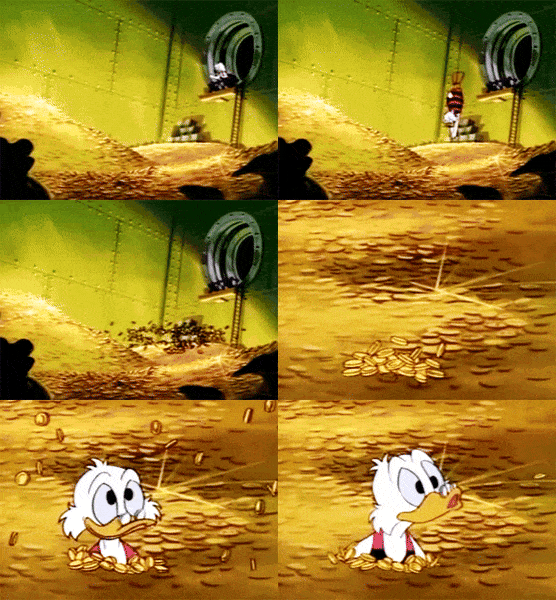
Recently, in my short, screen-time-constrained window of Instagram decompression, I saw a man—who, for the purposes of this essay, will remain a scribble, because he deserves no more attention than the algorithm has already siphoned toward him—explain his motivation for waking up at six and working all day. He narrated over an animation of Scrooge McDuck diving into a vault of gold coins.
I kept waiting for the turn. The wink. The line that would convert the spectacle into parody. It never came. I opened the comments expecting pushback; instead, I found applause.
And something in me recoiled.
Because Scrooge’s vault is not really a symbol of prosperity. It’s a symbol of stillness. A place where motion stops, where effort finally crystallizes into something you can stand still inside, where you no longer have to justify why you’re tired.
What disturbed me was realizing how cleanly we’ve absorbed the idea that rest is not something you’re entitled to because you’re human. It’s something you earn by surviving long enough to purchase the right.
We externalized stillness into a material goal, where rest is a commodity obtained only if you keep moving.
That is what, in my own meditations, I converged to call the hedonistic cogwheel. It doesn’t need to shove. It keeps placing the same offer in front of you, like a carrot on a stick: a future in which you’re finally allowed to stop. The wheel turns on trust—an assumption that effort will resolve into rest, that sacrifice will cash out into a life that feels owned rather than leased. Motion becomes a down payment. It signals that the bargain is still live, that you still belong.
This environment praises the people who volunteer for more, who stay reachable, who treat exhaustion as professionalism. It promotes the ones who demonstrate forward momentum without asking too many questions about where the road is going. And it doesn’t even need to threaten you. It simply rearranges things so that stillness looks like disengagement, and reframes disengagement to look like disloyalty.
This is why arrival has to remain impossible. If people were allowed to stop, they might notice what they traded away to keep moving. The wheel needs you to keep converting your present into a promised future, because the moment you demand the future in full, the terms look ugly.
The cruel part is how easily “later” stays intact even when the present deteriorates. More responsibility arrives wrapped in praise, in trust, in the warm, clean feeling of being wanted. For a moment it feels good in exactly the way being chosen feels good. Then the framing shifts under your feet. The new workload becomes normal. Availability becomes assumed. The old version of you who had evenings becomes a person you vaguely remember and don’t quite miss, because missing him would force you to ask what you traded.
And around you, the culture makes sure you don’t ask for long. You see who gets talked about with admiration. You see who gets described as “hungry” and “sharp” and “reliable.” You see who is always reachable and somehow always fine. You gain the quiet sense that slowing down will change how you are read.
To me the rat race is more than a cliché. You don’t have to be explicitly competing with anyone for the comparison to get inside you. It’s enough to absorb the idea that there is always a next rung, and that stopping means being placed on a different track. Promotions are perceived as a brief exhale before the next inhale. You look up almost automatically, and the self you were last year disappears from view.
That’s the trust piece, too. The bargain is never written down, which is why it survives so long. You lend your energy forward on the belief that it will come back to you as rest, as autonomy, as a life with edges you control. Work hard, be seen, stay close, and you’ll earn your life back later.
Then one day the promise breaks, and it breaks the way one loses appetite. The tasks are still there. The goals are still there. Even the reasons are still there. But the part of you that used to lean into them has gone quiet, and no amount of narrating can make it move.
I’ve felt that quietness so many times already. A heaviness before opening the laptop. A strangely blank stare at tasks you used to enjoy, at work that used to be quintessentially fun. A sense of internal noncompliance that doesn’t respond to pep talks or fear. It’s the silence when the body simply declines to supply momentum.
When I say the work used to be “fun,” I don’t mean it was easy. I mean it satisfied what Bertrand Russell, in The Conquest of Happiness, identified as the core of fulfilling work: the exercise of skill and the construction of something that persists.
I keep returning to Russell because his definition has become a kind of moral compass for me—a way of asking whether the fatigue is justified. There is a specific zest in real work, a tangible connection between the effort you expend and the value that materializes in front of you. It is the feeling of stacking bricks to make a wall, where the ache in your arms is answered by the shelter standing before your eyes.
This is where the breakage happens. It is where the logic of the careerist—the “Rider,” to borrow Jonathan Haidt’s metaphor—loses control of the emotional, instinctive “Elephant” beneath him.
For years, the Rider has been whispering a specific promise: Endure this now. Ignore the exhaustion. Navigate this politics. We will reach the clearing. The Elephant, being a creature of trust and habit, agrees. It charges forward. It tramples its own needs. It ignores the scenic route.
But the Elephant has a long memory, and it eventually notices that the clearing never arrives. The promotion was a vehicle for increased wages, and the increased wages were immediately swallowed by increased expectations. The reward for winning the pie-eating contest is just more pie. What looked like a path was a loop.
That heaviness I described—the stare, the noncompliance, the body declining to supply momentum—is my Elephant sitting down. Heartbroken. It is staging a sit-in because the contract has been violated. The Rider can scream about deadlines, about obligations, about everything that is supposedly at stake. The Elephant simply lies there, unmoved, because it has learned that moving does not lead anywhere it wants to go.
Organizations that run on this dynamic do not announce themselves as extractive. They speak the language of growth, of opportunity, of trust. They offer you more responsibility wrapped in the warm feeling of being chosen. And for a while, the warmth is real. But the structure beneath it is designed to ensure that the clearing never arrives—because if it did, you might stop. You might look around. You might ask what the effort was for.
We conflate “real work” with financial incentives, as if the soul were an accountant who could be satisfied by a raise. But the soul does not care about the next tax bracket. It cares whether the bricks are becoming a wall or vanishing into someone else’s quarterly earnings. It cares whether the effort feels like contribution or fuel.
In this silence, I find myself thinking of Don McLean’s Vincent. It is a song often reduced to a sentimental tribute to a tortured artist, but if you sit with it, it is a meditation on empathy delayed—on offering something beautiful to a world too busy moving to receive it.
They would not listen, they’re not listening still
Perhaps they never will
- Vincent, by Don McLean
McLean sings of a “sanity” that Vincent suffered for. In the logic of the cogwheel, sanity is often framed as capacity—the ability to keep up, to endure, to swallow the fatigue. But perhaps the Elephant sitting down is the only sane response to an arrangement that was never going to deliver what it promised. Perhaps the madness is continuing to dive into the empty vault, hoping that this time, the gold will be soft.
We want our work to matter. We want the beauty to survive the maker. The cogwheel offers a different deal: survive the making, only to find that what you made has already disappeared, absorbed into a ledger that keeps no record of your name.
Realizing this comes with a grief that no productivity hack can cure. But it also comes with something quieter. Once the Elephant sits down, you finally have a chance to look at where you are, rather than where you were promised you would be. You can stop searching for the vault. You can start looking for the wall you actually want to build.