Convenience and Contempt
Parsimony in Chasing Verisimilitude, I: Fidelity

This is the first essay in a three-part manifesto on fidelity, convenience, and the systems that shape how we consume work.
On most Sunday evenings I end up doing the same small ritual. I sit down, pick up my Hifiman Devas, and start fiddling with the cable that runs into the cups. The connection is flimsy, the headphones are on their second life, and I know from experience that a careless movement will cut the sound in one ear. I have sent them back before. I knew they were finicky when I bought them. I bought them anyway.
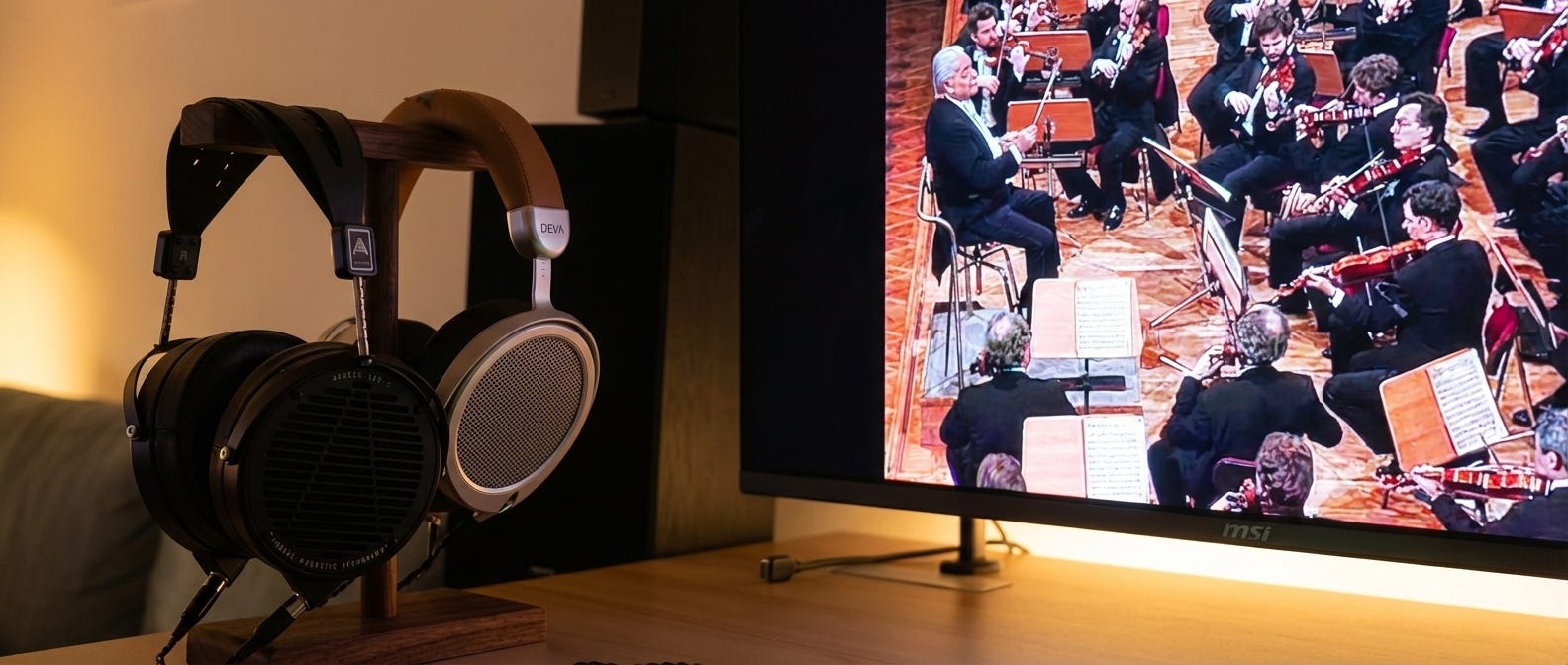
For most of the week that trade feels stupid. They are awkward to store, too open for the office, and the build quality inspires exactly zero confidence. But on the nights when I have an hour with nothing scheduled and no one talking to me, they still do something nothing else in my house can. I put on Celibidache’s recording of Dvořák’s Ninth, the Devas settle over my head, and the room changes shape. The strings start to swell, the winds answer, and for a few minutes I have the unnerving impression that the orchestra is not just playing in front of me but leaning in my direction. It is an illusion, of course, yet it is an illusion that feels earned. The drivers are doing their job. The recording engineer did his. Celibidache did more than his. My part is to sit there and not break the spell.
None of this is necessary. Celibidache himself thought the whole idea of recording was a mistake. For him, music was an event in a room, shared by people who had chosen to be there. Capture it on tape, slice it into tracks, sell it as “the work”, and something essential has already been removed. What reaches me through my Devas is, by his standards, a fossil. No hall, no air, no audience, no risk. Just a stereo image of something that once happened.
I listen anyway. I am grateful that someone ignored his wishes and pressed record. I am also aware that this is already a compromise. The ritual exists to force a small choice: accept some inconvenience and fragility in order to take someone else’s work seriously.
The same tension shows up in smaller, hotter ways in the kitchen. In the morning I grind coffee by hand because I like the resistance. The beans crackle, the handle turns, and a smell starts to creep out that is nothing like the bag it came in. When the water hits the bed it thickens into something sharper and more specific, a mix of orange peel, toasted hazelnut and something darker underneath that I still cannot name. The first sip is almost always the same: a quick shock of heat, then citrus at the edge of the tongue, then a sweetness that only appears if I was paying attention when I dialled in the grind.
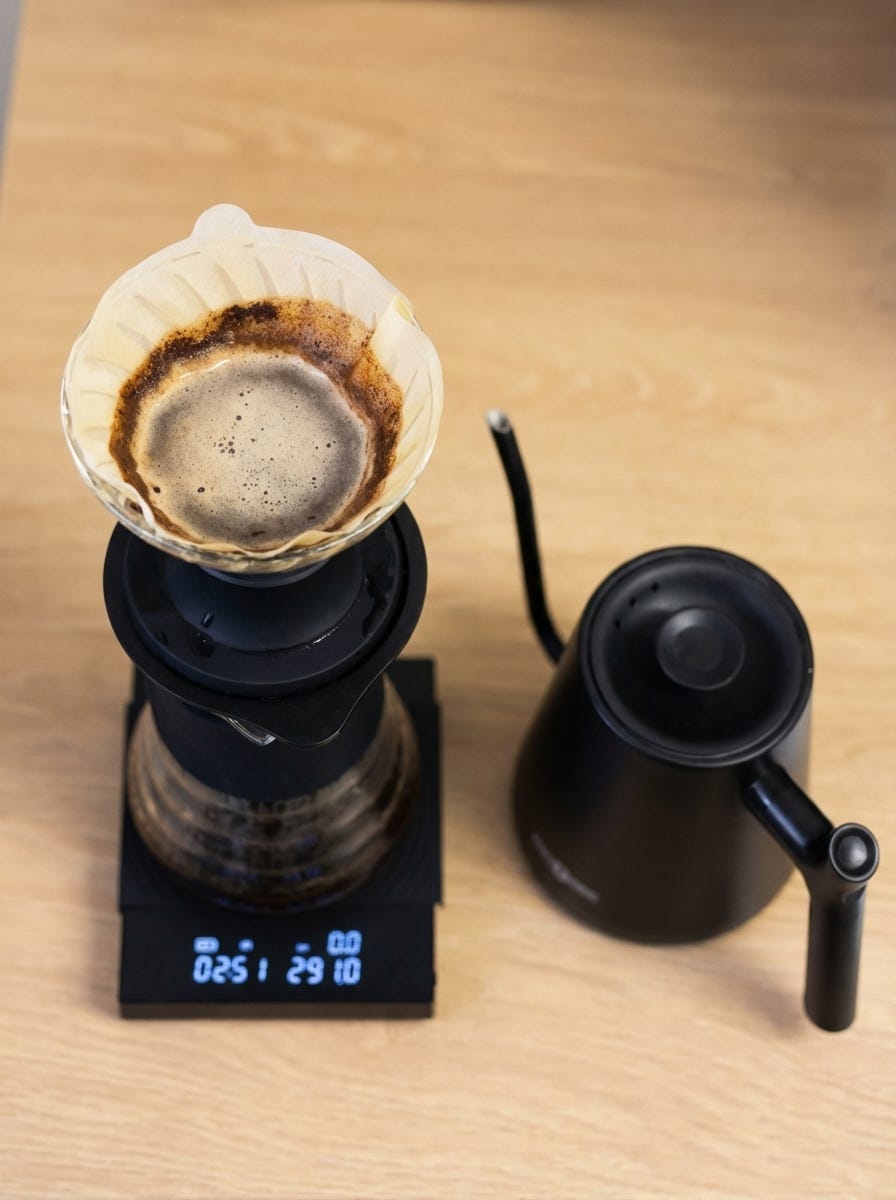
Again, none of this is strictly necessary. I can get Kenyan coffee delivered to Zürich in two days, vacuum sealed, barcoded, optimised for logistics. I can press a button on a capsule machine and get something called espresso in fifteen seconds. The global supply chain that makes this possible is a kind of miracle. It also flattens almost everything that makes the cup worth drinking. Growing, picking, processing, roasting, brewing, all of that labour is squeezed into a tracking number and a slogan. The sculpture loses the marks of the chisel that made it what it is.
At some point you have to ask what you are optimising for. Indifference to fidelity wipes away difference. Obsession with fidelity is a different caricature. It drifts into gear cults and anxious rituals, until you spend more energy tending to cables and grinders than to the performance or the cup.
There is a Pareto frontier between fidelity and convenience. Beyond a point, chasing verisimilitude turns fragile and self-indulgent. Below a point, convenience turns into a kind of contempt. The question is not which slogan you like, “audiophile” or “minimalist”, but where that frontier actually ends up in the way you move through a day.
For me it moves. Some days I drink capsule coffee with no guilt because I am late and the day has other demands. Some days I use cheap earbuds on the tram and let music blur into the background. That is fine. The trouble starts when that level of degradation becomes the default and attention the exception. If every cup is an afterthought and every piece of music is wallpaper under a feed, I begin to lose the habit of giving any one human work a clear stretch of time. At that point what is at stake is the act of sitting still long enough to meet a piece of work at all.
This is where Celibidache starts to feel less like an eccentric and more like a warning. His refusal to record looks extreme, but it was also a defence of the conditions under which real listening can happen. He was intolerant of degraded formats because he thought they would slowly redefine the work downward. If what most people meet of a symphony is a thin, compressed slice leaking from laptop speakers while they answer email, then the symphony itself has quietly shifted into a different category.
Most people will never hear Celibidache in a hall. Tickets, travel, time, those belong to a small slice of the world. Recordings are the only contact most of us will ever have with performances like his. That fact makes the question of how we listen more, not less, important. At some point the chain of compression, buffering and distraction produces something that still carries the artist’s name but no longer carries their intention. When that state becomes ordinary, you do not just accept a lower bitrate, you make yourself harder to move.
Bertrand Russell, writing about happiness almost a century ago, kept coming back to a very simple idea: people are happiest when they are absorbed in something outside themselves. Work, love, thinking, even simple play. The antagonist in that book is not hardship but a kind of restless boredom, a life spent half engaged with everything and fully engaged with nothing. Convenience does not stand apart from that. It nudges you toward shallow contact with a larger and larger stream of things.
In that light, fidelity is a double gesture. It acknowledges the artist or the farmer or the engineer, and it keeps your own capacity for serious enjoyment from drying out. To take the time to grind the coffee, to sit still for a slow Dvořák, to listen with decent headphones that might break again next month, makes little sense on a spreadsheet. It makes sense if your aim is to remain capable of being seized by something.
Purity tests bore me. What I want is to keep at least a few places in my life where I refuse the cheapest available version of a thing, even when no one is watching. A cup brewed with some care. An evening where music is the only task. A book read without parallel screens. All of these are small, local acts of fidelity.
Everyone will draw this line differently. The work is to notice where convenience has quietly crossed your own frontier, where it has turned from kindness into erosion. Somewhere between the capsule and the hand grinder, between the phone speaker and the fussy planar headphone, there is a line that is worth drawing. You do not have to justify it to anyone. You only have to stay on the better side of it often enough that one human piece of work can still reach you unflattened, without having to fight your entire life for a sliver of attention.